
Marketing Fundamentals Report
Introduction
Marketing is one of the most important functions of any successful business. It connects a business with its target customers, communicates the value of products or services, creates awareness, generates demand, and supports long-term customer relationships. While marketing was traditionally associated with advertising and sales promotion, modern marketing is much broader. It includes research, customer analysis, branding, content, search engines, social media, email, paid advertising, customer experience, analytics, and relationship management of Marketing Fundamentals.
The fundamental purpose of marketing is to understand customers and create value for them. A business may have a high-quality product or service, but without understanding its market and communicating its value effectively, reaching the right customers can be difficult. Marketing therefore starts before a product is promoted and continues after a customer makes a purchase.
Digital transformation has also changed how customers discover, compare, and purchase products and services. People can search Google, read reviews, compare competitors, watch videos, visit websites, and interact with brands on social media before making a decision. As a result, businesses need a structured marketing approach that combines fundamental marketing principles with appropriate digital channels.
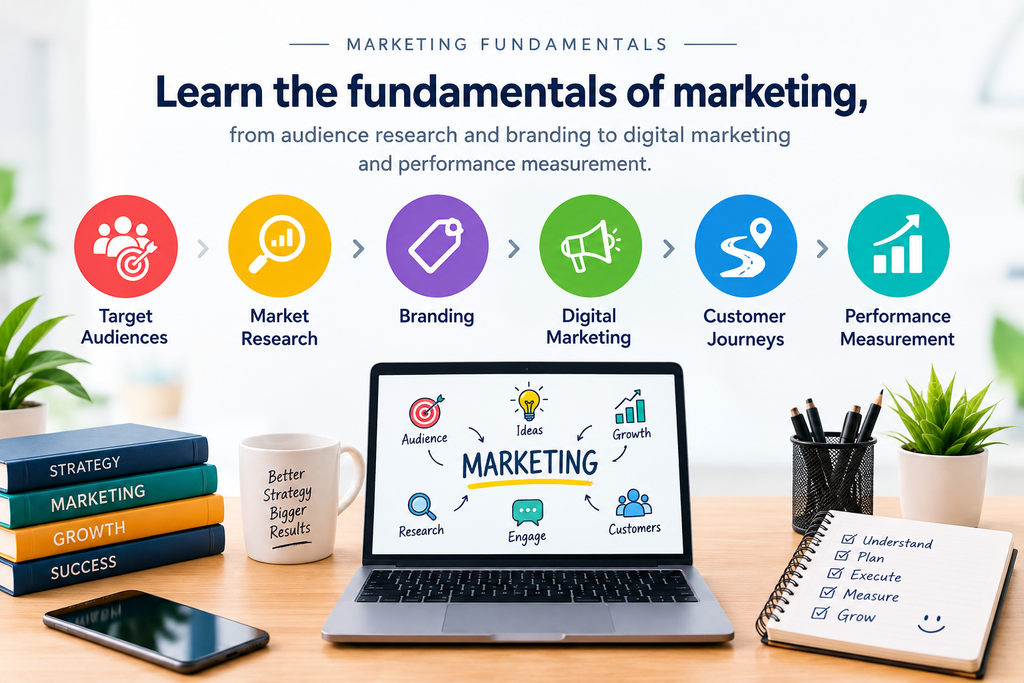
This report explains the major concepts of marketing fundamentals, including market research, target audiences, customer needs, segmentation, positioning, branding, the marketing mix, digital marketing, customer journeys, marketing objectives, measurement, and continuous improvement.
1. What Are Marketing Fundamentals?
Marketing fundamentals are the basic principles and processes that help a business understand its market, identify customer needs, communicate value, and build profitable customer relationships. These principles provide a foundation for both traditional and digital marketing strategies Marketing Fundamentals.
Key areas of marketing fundamentals include market research, customer analysis, segmentation, targeting, positioning, product development, pricing, distribution, promotion, branding, customer experience, and performance measurement.
A strong marketing strategy does not begin with the question, “What should we advertise?” It begins with questions such as: Who are our customers? What problem are they trying to solve? What alternatives are available to them? Why should they choose our product or service? Where do they look for information? What factors influence their decision?
Answering these questions allows businesses to develop marketing activities that are relevant to real customer needs instead of relying on assumptions.
2. Understanding the Target Audience
Identifying the target audience is one of the first steps in effective marketing. A target audience is the group of people or organizations most likely to need, want, and purchase a particular product or service.
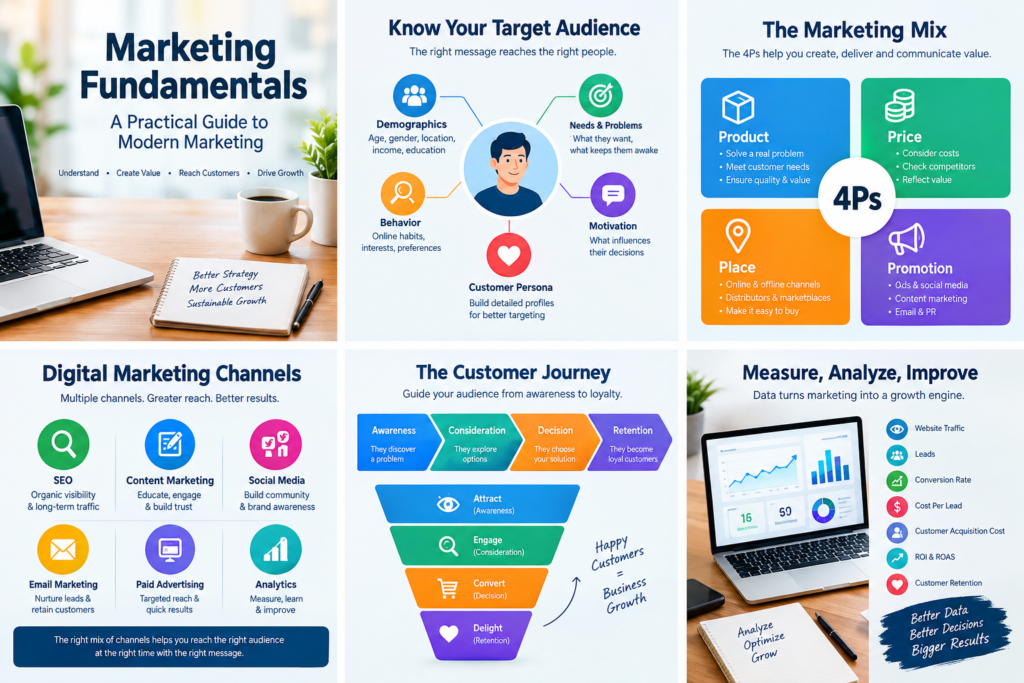
Businesses can define their audiences using demographic, geographic, behavioral, and psychographic characteristics. Demographic information may include age, occupation, income, education, or company size. Geographic information can include country, city, region, or service area. Behavioral information may include purchasing habits, website behavior, product usage, and previous interactions with a brand. Psychographic information can include interests, values, preferences, motivations, and lifestyle.
For B2B marketing, additional factors may include industry, company size, job role, decision-making authority, business challenges, and purchasing process.
Creating customer personas can make audience research easier. A persona represents a typical customer and summarizes their needs, problems, goals, objections, and preferred communication channels. For example, a small business owner may be interested in affordable marketing services but may also be concerned about measurable results, budget, and implementation time.
Understanding the audience helps businesses create better products, messages, offers, and marketing campaigns. It also helps reduce wasted marketing resources by focusing attention on people who are more relevant to the business Marketing Fundamentals.
3. Market Research and Competitor Analysis
Market research provides information about customers, competitors, industry conditions, trends, and opportunities. It helps businesses make informed decisions before investing significant resources in products or campaigns.
Research can be conducted through customer interviews, surveys, online research, industry publications, reviews, search behavior, competitor websites, social media, and internal business data. Businesses can also analyze common customer questions and problems to identify opportunities for useful products or content.
Competitor analysis is another important part of market research. A business can study competitors’ products, pricing, positioning, website experience, content, reviews, social media activity, and promotional methods.
In digital marketing, competitor research can also include search visibility, keywords, content topics, backlinks, advertising messages, and landing pages. The purpose is not simply to copy competitors. Instead, research should identify market gaps and areas where a business can provide greater value or communicate more clearly.
Good research reduces uncertainty. It allows marketers to understand what customers expect, what competitors already provide, and where opportunities for differentiation may exist Marketing Fundamentals.
4. Customer Needs and Value Proposition
Successful marketing is based on customer value. Customers generally purchase products or services because they solve a problem, satisfy a need, save time, reduce risk, provide convenience, create an experience, or deliver another meaningful benefit.
A value proposition explains the value a business provides to a specific audience. A useful value proposition answers three basic questions: Who is the customer? What problem or need does the business address? What meaningful benefit does the customer receive?
For example, a company selling business internet services might focus not only on connection speed but also on reliable connectivity, business continuity, support, and productivity. The specific value proposition should reflect what matters most to its target customers.
A clear value proposition helps guide website copy, advertisements, sales messages, social media content, and other communications. It also gives customers a reason to consider one business over available alternatives Marketing Fundamentals.
5. Market Segmentation, Targeting, and Positioning
Market segmentation divides a broad market into smaller groups with similar characteristics or needs. Common segmentation methods include demographic, geographic, behavioral, psychographic, and firmographic segmentation.
After identifying segments, a business can select the groups it wants to serve. This is the targeting stage. Businesses may choose one primary segment or several segments depending on their resources, products, and objectives.
Positioning is how a business wants its product or service to be understood in the minds of its target customers compared with alternatives. Effective positioning is clear, relevant, credible, Marketing Fundamentals and consistent.
For example, two companies may sell similar services but position themselves differently. One may focus on affordability, another on premium service, and another on specialized expertise. Positioning influences messaging, branding, pricing, content, and customer experience.
STP—segmentation, targeting, and positioning—helps businesses avoid trying to communicate the same message to everyone. More focused marketing can make communication more relevant and easier for customers to understand.
6. The Marketing Mix: The 4Ps
The marketing mix is a classic framework used to organize key marketing decisions. The traditional model includes Product, Price, Place, and Promotion.
Product refers to what the business offers. It should meet a real customer need and provide meaningful value. Product decisions can include features, quality, design, packaging, service, warranties, and variations Marketing Fundamentals.
Price refers to what customers pay. Pricing decisions should consider costs, competition, customer willingness to pay, market conditions, and perceived value. Different pricing models may include one-time purchases, subscriptions, packages, or usage-based pricing.
Place refers to how customers access the product or service. Distribution may involve physical stores, sales representatives, websites, marketplaces, distributors, or delivery networks.
Promotion refers to communication activities used to inform and persuade customers. Promotion can include advertising, public relations, content marketing, SEO, social media, email marketing, events, and sales promotion.
The 4Ps should work together. A premium product, for example, may require appropriate pricing, distribution, branding, and communication that support its positioning Marketing Fundamentals.
7. Branding and Brand Identity
Branding is the process of creating a recognizable identity and perception for a business, product, or service. A brand includes much more than a logo. It can include visual identity, messaging, tone of voice, positioning, customer experience, reputation, and the expectations customers associate with the business.
A consistent brand makes communication easier across different channels. Website pages, social media profiles, advertisements, packaging, emails, and sales materials should communicate a coherent identity Marketing Fundamentals.
Trust is especially important in modern marketing. Customers can quickly compare businesses, read reviews, and search for information before purchasing. Consistent communication and a reliable customer experience can support credibility.
Branding should also be connected to the actual value delivered by the business. Strong design cannot compensate for a poor product or customer experience. The brand promise should be supported by real business performance.
8. Digital Marketing Fundamentals
Digital marketing uses online channels and technologies to reach, engage, convert, and retain customers. It has become an important part of modern marketing because customers increasingly use digital platforms throughout the buying journey of Marketing Fundamentals
Search Engine Optimization helps businesses improve organic visibility in search engines. Content marketing provides useful information that can educate audiences and support different stages of the customer journey. Social media marketing helps businesses build awareness and communicate with communities. Email marketing supports direct communication and lead nurturing. Paid advertising allows businesses to reach selected audiences through search engines, social platforms, video platforms, and other digital networks.
A business does not necessarily need to use every digital channel. The right channel mix depends on the target audience, business model, budget, goals, and customer journey.
For example, a local service business may benefit from local SEO, Google Business Profile optimization, reviews, and location-based content. A B2B company may focus more on SEO, LinkedIn, educational content, email, and lead generation. An e-commerce business may combine SEO, product content, paid advertising, social media, email, and conversion optimization.
9. Content Marketing
Content marketing focuses on creating and distributing useful, relevant content for a defined audience. Content can include blog articles, videos, guides, case studies, infographics, social media posts, newsletters, webinars, and other educational resources Marketing Fundamentals
Effective content should address genuine audience questions and problems. Instead of creating content only to promote a product, businesses can educate potential customers and help them make informed decisions Marketing Fundamentals.
Content can support the entire customer journey. Educational content may attract people during the awareness stage. Comparison guides and case studies can help during consideration. Product information, demonstrations, FAQs, and testimonials can support purchase decisions.
Search intent is particularly important for SEO content. A person searching for “what is technical SEO” has a different need from someone searching for “SEO agency pricing.” Understanding intent helps marketers create content that matches what users actually want.
10. Customer Journey and Marketing Funnel
The customer journey describes the stages a person goes through when interacting with a business. A simplified model is Awareness, Consideration, Decision, and Retention.
At the awareness stage, customers recognize a problem or discover a potential solution. Marketing can provide educational content, social posts, videos, or search visibility.
During consideration, customers research options. They may compare products, read reviews, visit websites, examine pricing, and evaluate alternatives. Detailed content, comparison pages, case studies, and FAQs can help Marketing Fundamentals
At the decision stage, customers need confidence to take action. Clear offers, product information, testimonials, transparent pricing where appropriate, strong calls to action, and an easy purchasing process can reduce friction Marketing Fundamentals.
After purchase, retention becomes important. Businesses can use customer support, email communication, loyalty programs, useful resources, and personalized offers to encourage repeat business and referrals.
Understanding the customer journey helps marketers provide the right information at the right stage instead of using the same message for everyone.
11. Setting Marketing Goals and Objectives
Marketing activities should be connected to clear business objectives. Without measurable goals, it can be difficult to determine whether a campaign is successful.
Common marketing goals include increasing brand awareness, generating qualified leads, increasing sales, improving website traffic, increasing customer retention, improving conversion rates, and reducing customer acquisition costs.
SMART goals provide a useful structure: Specific, Measurable, Achievable, Relevant, and Time-bound. Instead of saying “increase website traffic,” a business might establish a specific target for organic traffic within a defined period Marketing Fundamentals.
Goals should also connect marketing metrics to business outcomes. High website traffic may be useful, but traffic alone does not necessarily mean business growth. Marketers should consider whether visitors are relevant, whether they engage with the website, and whether they become leads or customers Marketing Fundamentals.
12. Marketing Analytics and Performance Measurement
Measurement allows marketers to understand what is working and where improvement is needed. Important metrics depend on the marketing channel and business objective.
Website metrics may include sessions, engagement, landing-page performance, conversions, and traffic sources. SEO metrics may include organic traffic, keyword visibility, impressions, clicks, click-through rate, and conversions from organic search. Paid advertising can be evaluated using metrics such as impressions, clicks, conversion rate, cost per click, cost per lead, and return on advertising spend.
Email marketing can be measured using delivery, opens, clicks, conversions, and unsubscribe rates, while social media may include reach, engagement, clicks, and conversions Marketing Fundamentals.
The key principle is to measure meaningful outcomes rather than collecting numbers without context. Marketing dashboards should help decision-makers understand performance and determine what action should be taken next.
13. Customer Retention and Relationship Marketing
Marketing does not end after a customer makes a purchase. Retaining existing customers can be an important part of long-term business growth.
Relationship marketing focuses on building ongoing connections with customers. Businesses can support relationships through good customer service, personalized communication, helpful content, loyalty programs, follow-up emails, product education, and responsive support.
Customer feedback is also valuable. Reviews, surveys, support requests, and direct conversations can reveal problems and opportunities for improvement.
Satisfied customers may also recommend a business to others. Therefore, customer experience can influence both retention and future acquisition.
14. Common Marketing Mistakes
Several common mistakes can reduce marketing effectiveness. One is trying to target everyone with the same message. Without a clear audience, marketing communication can become too broad.
Another mistake is focusing only on promotion while ignoring product quality, customer experience, or value. Marketing may create initial interest, but the overall customer experience determines whether that interest becomes a lasting relationship.
Businesses may also make the mistake of using too many channels without enough resources to manage them effectively. It is usually better to select channels that match the audience and objectives.
Other common mistakes include failing to measure results, relying on assumptions instead of research, producing content without a clear purpose, ignoring mobile users, and changing strategy too frequently without allowing enough time to evaluate results.
Avoiding these mistakes requires research, clear goals, consistent execution, and regular analysis Marketing Fundamentals.
15. The Role of AI in Modern Marketing
Artificial intelligence is increasingly being used in marketing for tasks such as data analysis, content ideation, customer segmentation, personalization, automation, and research. AI tools can help marketers process information faster and explore different ideas Marketing Fundamentals.
However, effective marketing still requires human judgment. Marketers need to understand customer context, brand positioning, business goals, accuracy, ethics, and the quality of the customer experience.
AI-generated content should also be reviewed for accuracy, originality, usefulness, and brand alignment. Businesses should avoid publishing low-quality content simply because it can be produced quickly.
The practical role of AI is therefore best understood as a tool that can support marketers rather than a replacement for strategic thinking. Human expertise remains important for deciding what information matters, what customers need, and how a business should communicate its value.
16. Creating an Integrated Marketing Strategy
An integrated marketing strategy connects different marketing activities so that they support the same business goals and communicate consistent messages.
A practical process can begin with market research and customer analysis. The business can then define its target audience, value proposition, positioning, goals, and key messages. After that, it can select the most appropriate marketing channels.
For example, SEO can attract people through organic search, while content can educate them. Social media can distribute content and build awareness. Email can nurture leads. Paid advertising can support targeted campaigns. Website conversion optimization can make it easier for visitors to take action.
Integration does not mean using every channel equally. It means ensuring that selected channels work together rather than operating as isolated activities.
A documented strategy can define target audiences, objectives, channels, content themes, budgets, responsibilities, timelines, and key performance indicators.
17. Continuous Improvement
Marketing is an ongoing process. Customer behavior, competitors, technology, platforms, and market conditions change over time. A strategy that works today may need adjustment in the future.
Continuous improvement involves planning, implementing, measuring, learning, and optimizing. Marketers can test different headlines, offers, landing pages, content formats, audiences, and communication methods.
The goal is not to change everything at once. Controlled testing makes it easier to understand what caused an improvement or decline.
Regular performance reviews can help businesses identify successful activities, inefficient spending, new customer needs, and emerging opportunities. Data and customer feedback should work together to guide future decisions Marketing Fundamentals.
Conclusion
Marketing fundamentals provide the foundation for effective business growth. They begin with understanding customers and the market and continue through positioning, branding, product decisions, promotion, customer experience, measurement, and retention.
Modern marketing combines these fundamental principles with digital channels such as SEO, content marketing, social media, email, paid advertising, analytics, and AI-supported tools. The most important principle is not simply to use more channels, but to use the right channels for the right audience and objective.
A successful marketing approach is customer-focused, research-driven, measurable, and adaptable. Businesses that understand their customers, communicate clear value, deliver a consistent experience, Marketing Fundamentals .and continuously improve their strategies can build stronger relationships and create sustainable marketing performance over time Marketing Fundamentals.